Cameras home over the internet
Reliable transport over an ordinary internet connection, built for the packet loss and jitter of the public internet, and encrypted on the way. Broadcast picture quality, with up to 16 audio channels per camera.

Your cameras come home over an ordinary internet line, arrive in step with each other, and the programme and talkback go back to the crew. Small boxes at the venue, no booked circuit, no IT on site.
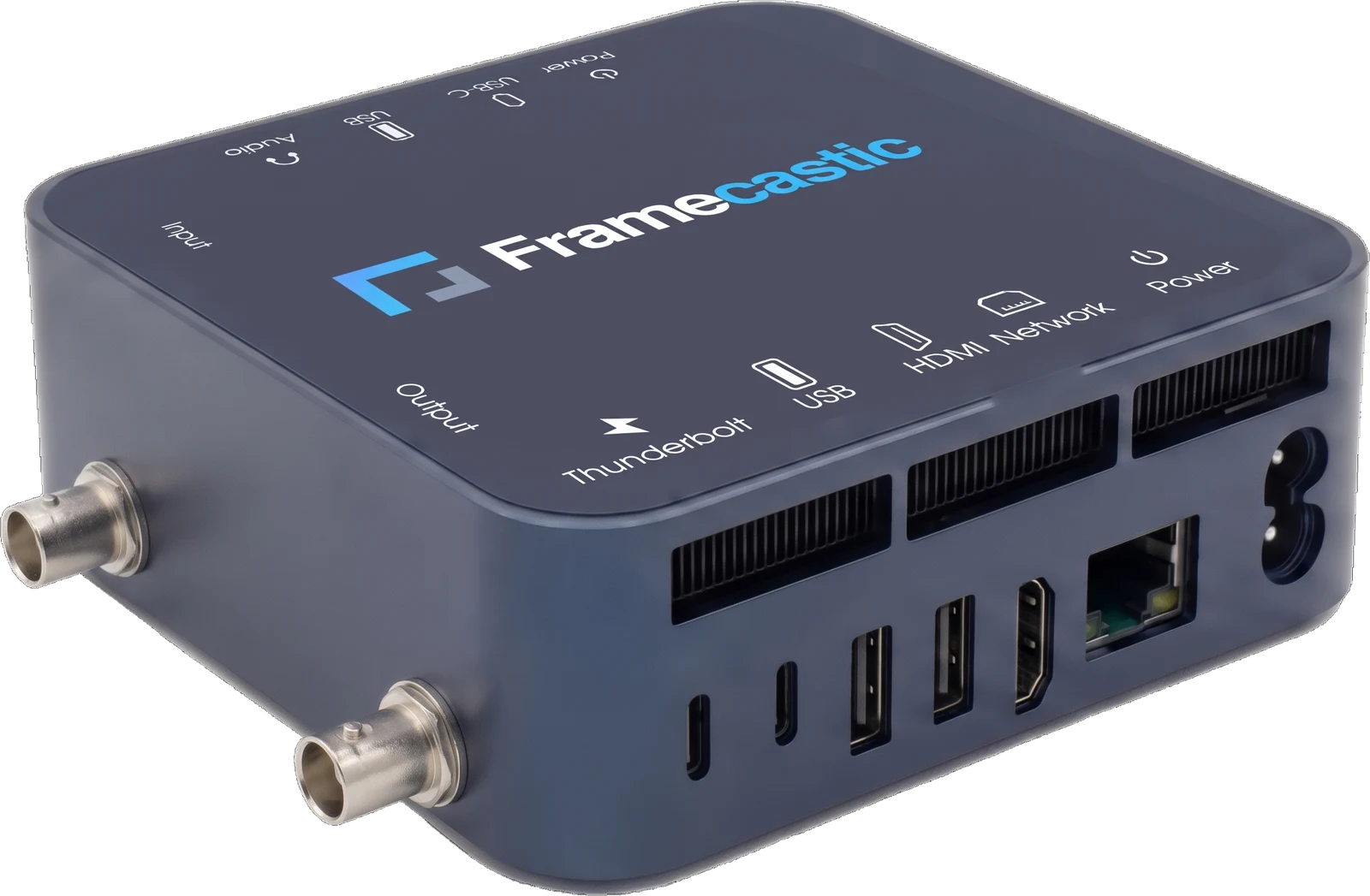
Sending a full crew and an OB truck to every event is expensive, and a booked circuit is rarely worth it for second-tier sport, regional news or a single camera position. Remote production keeps the production team at home. For that to work, the pictures have to arrive reliably over the public internet, the director has to be able to cut between cameras as if they were in the same building, and the crew at the venue still has to see and hear what is on air.
Each camera goes into a small Framecastic unit, which sends it home over the internet.
The cameras come back out as SDI for your vision mixer, lined up with each other.
The programme goes back on the same box, so the crew sees what is on air.
The crew hears the gallery through the same box's headphone output.
Reliable transport over an ordinary internet connection, built for the packet loss and jitter of the public internet, and encrypted on the way. Broadcast picture quality, with up to 16 audio channels per camera.
Cameras sent over the internet arrive at slightly different moments. Our decoder lines them back up using the timecode each camera carries, so the director cuts between them just as in the building. If one camera drops out, the others stay in step; when it returns, it is brought back into line by itself.
The Portable Codec sends and receives at the same time, so the return feed comes out of the same small box. No second unit at the venue.
The box has a headphone output for a talkback line from the gallery. It works with standard SIP today, and we are happy to talk about connecting it to the intercom system you already use.
The unit connects home by itself and works behind the venue's firewall without anyone opening a port, so we can also support it remotely. Everything is set in a browser.
Each stream can be set for low latency, for live cutting and the return feed, or for the best picture where a little more delay does not matter.
A test tone on the talkback output and test patterns on the decoder prove the path from end to end before the cameras are live.
About 10 W from the wall and no rack needed.
| Where | Unit | What it does |
|---|---|---|
| At the venue, one camera | Portable Codec | Camera out, programme and talkback back |
| At the venue, several cameras | Compact SDI Codec | Several cameras from one desktop box |
| In the gallery | SDI Decoder | Up to 16 cameras back on SDI, lined up |
| In the gallery, programme back | Portable Codec or SDI Encoder | Sends the programme to the venue |
| Network | An ordinary internet line at the venue, with enough upload for your cameras |
Remote production with our Portable Codec: the camera goes home over the internet, and the on-air return comes back on SDI in the same box.
Remote access to a running unit first, then a unit at your venue for a couple of weeks, with a written report you keep either way.