
Broadcast encoders, decoders, a compact field codec and the IPTV systems that distribute and display the result. Part numbers, specifications and warranty live on this page, because this is the brand the products carry.
See the line Talk to usEvery device we build is the same recipe with different ingredients: a server or a small industrial box, capture and encode cards chosen for the job, network interfaces sized for the traffic, and Linux with our software on top. Nothing exotic in the parts list, and all of the difficulty in the timing.
Uncompressed video over IP using SMPTE ST 2110 with 25GbE networking, or baseband over SDI and HDMI with capture cards. The interesting problems here are clocking, packet pacing and what happens on the network when a switch has an opinion.
Encoding and decoding on Intel hardware rather than on the CPU. Most of the real work is finding out what a given silicon generation actually supports, as opposed to what its documentation implies, and then designing around the gap.
MPEG-TS over UDP and RTP for a managed network, SRT and RIST when the path is the public internet and packets will be lost. Adaptive HTTP delivery when the far end is a phone or a browser instead of a decoder.
Every device is driven by a REST API and a browser interface, because the people operating them are not the people who built them. That constraint shapes more of the design than any codec decision does.
Every product below carries a Framecastic part number and a specification table sourced from the same internal record we sell and support from. Where a printed datasheet does not exist yet, ask and we will send the current one.

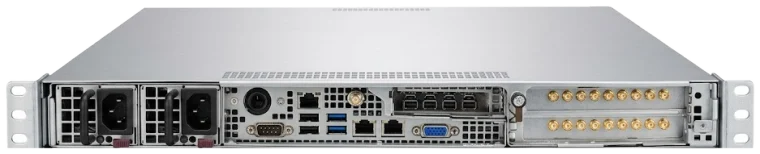
Takes uncompressed video and audio off a broadcast IP fabric and turns it into compressed MPEG-TS for distribution. The path a facility uses once it has moved to ST 2110 and needs the compressed side of the house fed.
| Input | SMPTE ST 2110-20/-30, 4× 25GbE across 2× dual-port 25GbE network cards, ST 2022-7 redundancy |
| Channels | 16 simultaneous, up to 1080p60 |
| Resolution | Up to 1920 × 1080 (HD). Not 4K/UHD. |
| Codec | H.264 / H.265. Audio: AAC-LC, Opus or MP2, up to 16 channels per stream |
| Timing | Hardware PTP via the 25GbE network card |
| Platform | 1U SuperMicro with redundant PSU |
| Management | Web dashboard + REST API |
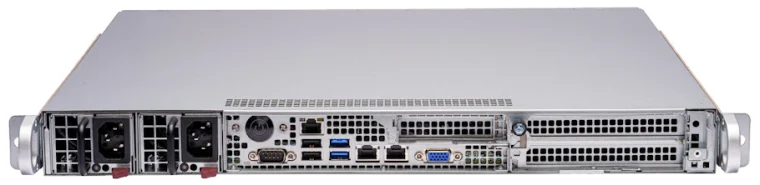
The same job from baseband. SDI in, compressed IP out, with the embedded audio carried through and tagged by language. For plants where the router is still SDI and the distribution is already IP.
| Input | SD/HD/3G-SDI (BNC), 2× SDI capture card Quad HDMI Recorder |
| Channels | 16 simultaneous, up to 1080p60 |
| Resolution | Up to 1920 × 1080 (HD). Not 4K/UHD. |
| Codec | H.264 / H.265. Audio: AAC-LC, Opus or MP2, up to 16 channels per stream |
| Output | MPEG-TS/UDP, multi-destination tee per stream, live thumbnails per channel |
| Management | Web dashboard + REST API |
HDMI sources into IP, which sounds simple until EDID, 4K and HDR handshakes are involved. Built for the enterprise and hospitality side, where the source is a media player or a set-top box rather than a camera.
| Input | Up to 8× HDMI |
| Channels | Up to 8 HD (1080p) or up to 2× 4K. Channel count scales with resolution. |
| Resolution | Up to 3840 × 2160, 8/10/12-bit, 4:2:0 / 4:2:2 / 4:4:4, HDR10 and HLG |
| EDID | 100+ presets, per-input selection |
| Audio | Stereo per HDMI input, Dolby DD/DD+ passthrough |

The reverse path. Compressed IP in, uncompressed ST 2110 video and audio back onto the fabric, for playout, monitoring or disaster recovery.
| Input | MPEG-TS: H.264, H.265 or MPEG-2 |
| Channels | Up to 16 simultaneous |
| Output | Uncompressed YCbCr 4:2:2 10-bit via ST 2110-20, up to 1920×1080; PCM 24-bit / 48 kHz stereo via ST 2110-30 |
| Redundancy | ST 2022-7 dual-path |
| Network | 2× dual-port 25GbE network cards (4× 25GbE), hardware PTP |
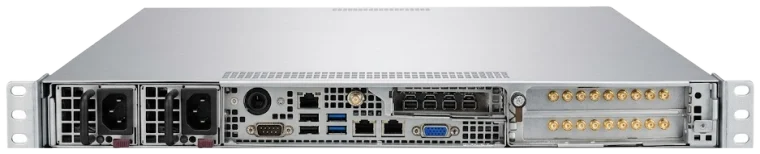
IP back to baseband SDI, which is still how most of a plant is wired. The bridge between an IP distribution network and the SDI equipment already installed.
| Output | 16× 3G-SDI (BNC) |
| Input | MPEG-TS/UDP, local files with seamless loop, built-in SMPTE test patterns |
| Codec | H.264, hardware decode |
| Output format | UYVY 4:2:2, up to 1920×1080, interlaced and progressive; PCM 16-bit stereo, 48 kHz |
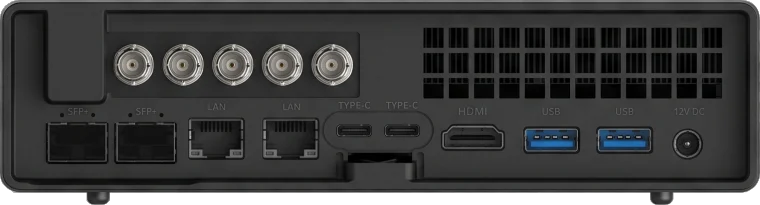
4 or 8 SDI channels in a small desktop chassis, each one independently an encoder or a decoder. For sites where four to eight channels do not justify a 1 RU rack server. Built on the same codec software as the rest of the SDI line.
| Channels | 4 (FC-CDX-4) or 8 (FC-CDX-8), any encode/decode mix |
| Codec | H.264 (4:2:0); HEVC 4:2:0 and 4:2:2, 8 and 10-bit. Hardware encode and decode. |
| Resolution | Up to 1920 × 1080 (HD). Not 4K/UHD. |
| Bitrate | True CBR, configurable up to 50 Mbps |
| Glass-to-glass latency | 12 to 14 frames, SDI in to SDI out, low-latency profile, measured at 1080p50 with an external instrument that never touches the unit. Quoted in frames because the figure moves by up to two frames across a restart of the same configuration. |
| Audio | Encode: up to 16 embedded SDI channels captured, arbitrary channel-to-track mapping, AAC / MP2 / Opus / PCM. Decode: up to 16 channels embedded onto SDI, with track-to-channel mapping. |
| Transport | UDP, RTP, SRT or RIST per stream, with per-stream DSCP marking |
| Decoder input | UDP, RTP, SRT, RIST, RTMP/RTMPS, RTSP, HLS, HTTP(S), local file loop, built-in test pattern |
| Management | On-device HTTPS UI behind login, full REST API, WireGuard dial-home |
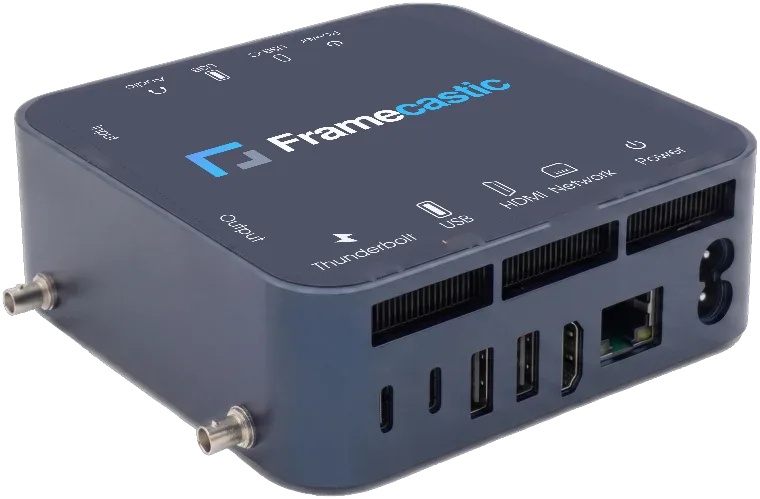
One SDI in and one SDI out, at the same time, in a small box. Built for field contribution and remote bureaus: send the programme out and take the return feed back on the same unit. Sold as our hardware, or as software on your own x86 machine with the same capture card.
| Channels | 1 encoder + 1 decoder. One SDI in and one SDI out simultaneously, fixed direction, not two of either. |
| Codec | H.264 (4:2:0); HEVC 4:2:0 and 4:2:2, 8 and 10-bit. Hardware encode and decode. |
| Resolution | Up to 1920 × 1080 (HD). Not 4K/UHD. |
| Bitrate | True CBR, configurable up to 50 Mbps |
| Audio | Encode: up to 16 embedded SDI channels captured, arbitrary channel-to-track mapping, AAC / MP2 / Opus / PCM. Decode: up to 16 channels embedded onto SDI, with track-to-channel mapping. |
| Transport | UDP, RTP, SRT or RIST per stream, with per-stream DSCP marking. Either end may be caller or listener. |
| Decoder input | UDP, RTP, SRT, RIST, RTMP/RTMPS, RTSP, HLS, HTTP(S), local file loop, built-in test pattern. These are inputs; the unit has no RTMP or HLS output. |
| Management | On-device HTTPS UI behind login, full REST API, WireGuard dial-home |
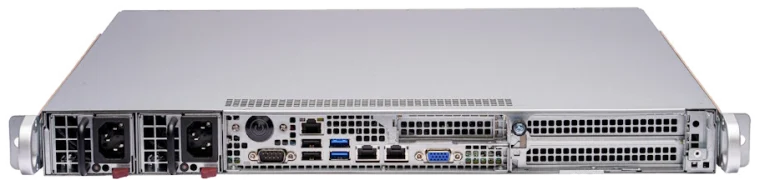
One live MPEG-TS in, an adaptive-bitrate HLS ladder out, with the decode, the scaling and every rung of the encode done in hardware on a dedicated media accelerator card. It is a working HLS ABR transcoder rather than a full OTT headend, and the row below says where that line falls.
| Input | Live MPEG-TS |
| Output | HLS with a master playlist, keyframes aligned across every rung so a player switches cleanly |
| Rendition codecs | H.264 or AV1, per rung |
| Capacity | Measured per accelerator card, and it depends on the ladder: 26 channels for 1080i50 in to 4× H.264 25p out, 22 for an all-AV1 ladder, 16 for 1080p50 to two renditions, 14 for three renditions on preset fast. |
| Per 1 RU | Up to 72, being 26 per card across three cards. |
| Not yet | No DASH, no DRM, no multi-language audio, no subtitles, no SCTE-35, no I-frame playlist for trick play, no input failover |
| Control | REST API for the stream lifecycle, device and health |
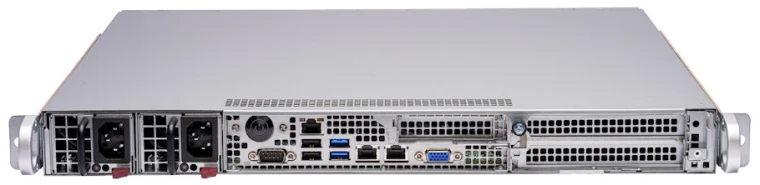
The control plane. Takes the compressed streams, manages the channel catalogue, and delivers to televisions on the network and to phones and browsers over adaptive HTTP.
| Channels | 100+ simultaneous |
| Output | UDP multicast/unicast, HTTP-TS, HLS, WebRTC |
| Input | MPEG-TS/UDP; H.264 video, AAC/Opus audio |
| Channel management | Add / edit / delete, groups, logos, M3U playlist for VLC/STB |
| Monitoring | Real-time per-channel viewer counts, live in-browser preview |
| Network | 10 GbE recommended |
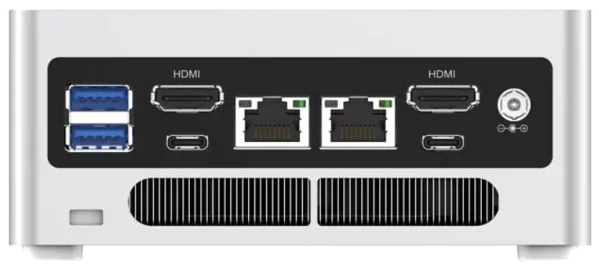
The screen end. Drives HDMI outputs from the channel catalogue, full screen or split into a wall of tiles, managed from the browser.
| Outputs | 2× HDMI, independent, up to 4K (fallback 1080p) |
| Streams | Up to 8 total, quad-split (2×2) per output |
| Input | UDP, RTP, HTTP, HTTPS, RTSP; H.264 video, AAC audio |
| Startup | Sub-2-second stream start, kiosk auto-boot |
| Physical | 115 × 32 × 115 mm, 0.4 kg, 20–50 W, external 12 V DC |
Every product on this page ships with two years of hardware warranty and one year of software updates included, at no extra cost. An optional annual SLA extends support and firmware after that. Software licences are perpetual: you buy them once and own them, not a subscription.
Every device on this page is a Framecastic product: our part number, our specification, our warranty. Buy finished, racked units, run the software on servers you already own, or take it white labelled. Licences are perpetual, with an optional annual SLA for support and updates.
Talk to us Try it on your own signals