Every channel, in two places at once
One encoder sends each channel to several destinations at once, over UDP, RTP, SRT or RIST, each with its own QoS class. A destination that fails does not stop the others.

Every channel goes to your operators as usual and, at the same time, to a second site, where it comes back as SDI or ST 2110 for the router there, ready to go on air.
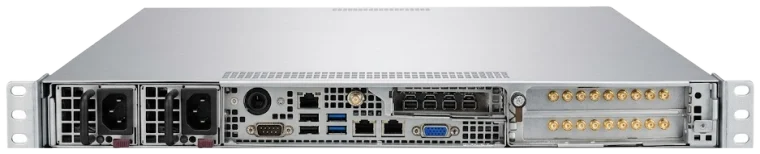
A broadcaster or playout centre runs its channels from one building. A power cut, a fire or a cut fibre takes them all off air at once. A second site usually means building the whole plant twice, and on the day it is needed nobody is sure the backup still works.
The encoders send every channel to your operators as usual and, at the same time, a copy to the backup site.
Over two separate networks with ST 2022-7, or over the internet with SRT or RIST.
A decoder brings every channel back to SDI or ST 2110, ready for the router there.
Your operators switch to the backup site. Any output can show a backup file in a loop or a test pattern instead of a feed.
One encoder sends each channel to several destinations at once, over UDP, RTP, SRT or RIST, each with its own QoS class. A destination that fails does not stop the others.
ST 2022-7 sends the same stream over two separate networks. When one path is lost, the other carries on with no gap.
SRT and RIST recover lost packets over an ordinary internet line, so the backup site does not need a dedicated fibre.
Up to 16 outputs per rack unit, as SDI or ST 2110, with up to 16 audio channels each.
Any output can be switched to a backup file in a seamless loop, or to colour bars, so there is always a picture to put to air.
Every 1 RU unit has two power supplies. Everything is set and watched in a browser or through the REST API, with remote support over WireGuard.
| Where | Unit | What it does |
|---|---|---|
| Main site | SDI Encoder | 16 channels in 1 RU, each to several destinations |
| Main site on ST 2110 | ST 2110 Encoder | 16 channels in 1 RU from your ST 2110 network |
| Backup site | SDI Decoder | Up to 16 channels back to SDI in 1 RU |
| Backup site on ST 2110 | ST 2110 Decoder | Up to 16 channels back onto ST 2110 |
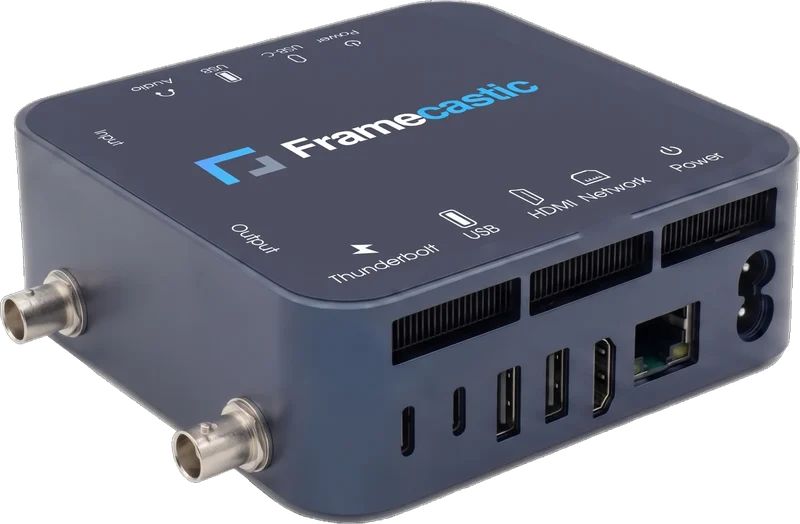
| A smaller site | Compact SDI Codec | 4 or 8 channels where there is no rack |

Sixteen channels per rack unit, each one delivered to every operator that takes it.
Channels and feeds that arrive over IP, back onto the SDI and ST 2110 equipment you already have.
Cameras home over the internet, in step in the gallery, with the programme and talkback back to the crew.
Remote access to a running system first, then a pilot between your main and backup site, with a written report you keep either way.